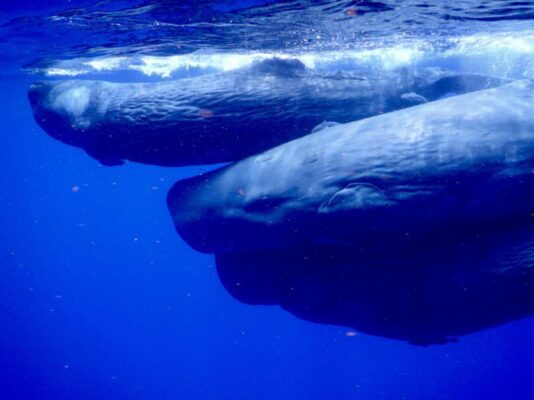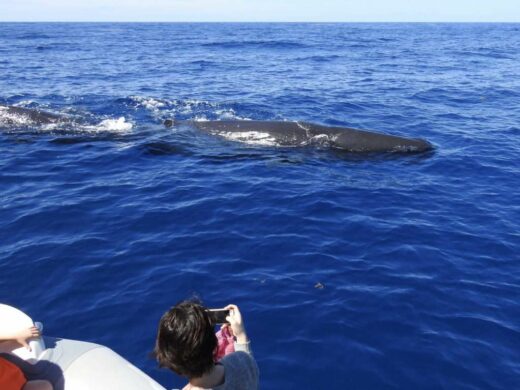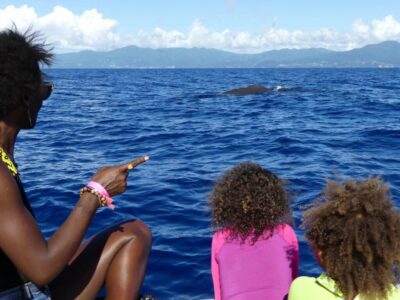
For thousands of years, humpback whales have maintained lasting ties with humans living near the coast. All over the world, they seek to get closer to humans, to share moments, to swim together, to exchange their songs, except in the Caribbean...
How can we explain this phenomenon?
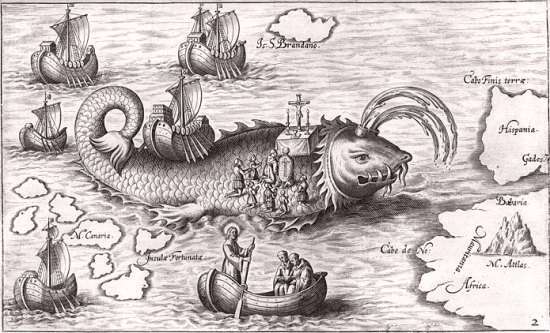
To understand this, we need to place the relationship between whales and indigenous peoples in a context dating back thousands of years. When Europeans explored the North in the 10th century, they were fascinated by the links between the natives and the whales. Medieval literature described the Arctic as a land inhabited by «monstrous fish» and people capable of magically summoning them.
Even the accounts of explorers and missionaries, describing the hunting and sharing of whales, were tinged with mysticism. In 1938, anthropologist Margaret Lantis spoke of a «circumpolar whale cult» among the Iñupiat, Inuit and other northern peoples, proving this link through taboos and rituals. A killed whale was often given fresh water, a meal and even travel bags to ensure its spiritual return. Every whaler had songs to attract them, and shamans held religious ceremonies in whalebone circles. Amulets, handed down from father to son, reinforced this mysterious relationship, incomprehensible to non-native observers, especially scientists, who resisted anything anthropomorphic.
The mysticism of northern peoples and their sacred link with whales
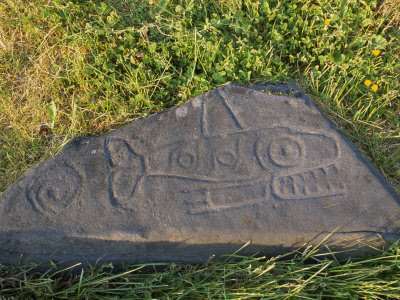
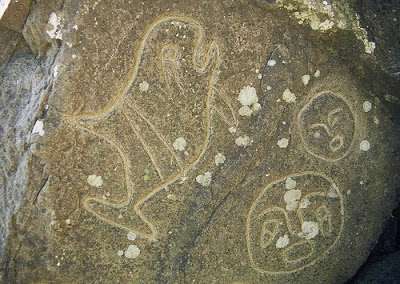
Along some Alaskan coasts, the rocks are covered with petroglyphs of men and whales.
They were carved by whaling shamans as part of rituals that enabled them to acquire the secrets of the sea and offer thanks for its generosity.
In archaeology, such attitudes have limited our understanding of Arctic prehistory," explains Erica Hill, zooarchaeologist at the University of Alaska Southeast. Whaling amulets and bone circles have been seen as ritualistic or supernatural, with little understanding of what they meant to the people who created them. Instead, archaeologists who have studied animal artifacts have often focused on the tangible information they have revealed about what ancient peoples ate, how many calories they consumed and how they survived.
Hill is part of a growing branch of archaeology that uses ethnographic narratives and oral histories to re-examine animal artifacts with fresh eyes and interpret the past in new, non-Western ways. «It interests me as part of our prehistory as humans," says Hill, "but also in what it tells us about other ways of being.
The idea that indigenous peoples have spiritual relationships with animals is so well established in popular culture that it's a cliché. Yet, constrained by Western science and culture, few archaeologists have examined the record of human history from the perspective that animals feel emotions and can express these emotions to humans.
The Tinglits of North West America, the Aborigines of South East Australia, the Maoris of Kaikoura, the Mayumba people of West Africa, the Hawaiians, the Polynesians and many others have forged powerful ties with these whales over thousands of years, based on respect and often exchange.
The exchange
Whale song can be found in the shamanic chants of the peoples who have listened to them for thousands of years, but human melodies can also be found in whale song...
(see The search for the lost music of the Kalinagos )
Respect
The Tinglits in particular consider them as such, and eating their flesh is likened to cannibalism. The Hawaiians call them «Koholas», the goddesses of the sea, who are surrounded by an immense sphere of Mana, pure energy, the guardian of spirituality.
The lost Caribbean link
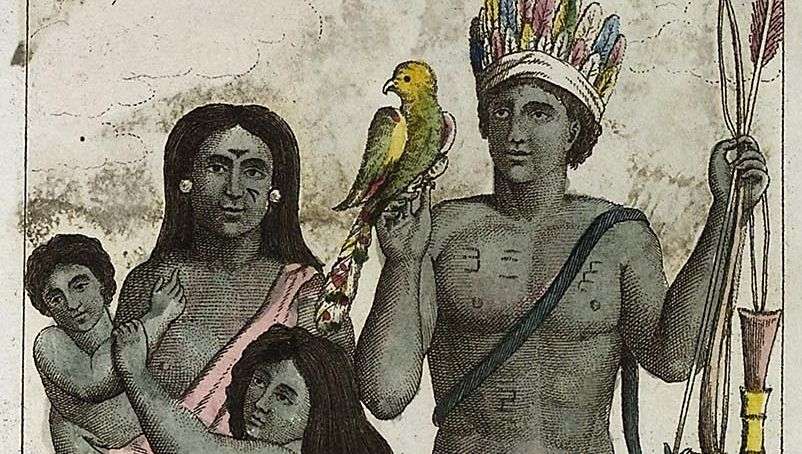
In the Caribbean, the pre-Columbian peoples certainly had these same links with the humpback whales, who considered these peoples as their family, until 1492...
In 1492, the arrival of the Europeans sounded the death knell for these civilizations: Kalinagos, Caraibes, Taïnos, Arrawaks, these peoples were gradually exterminated or assimilated, their culture and spirituality wiped out. The whales were traumatized by the genocide of their «family». From then on, they developed a legitimate mistrust of the «new» humans who now populate the Caribbean.
Pierre Lavagne de Castellan
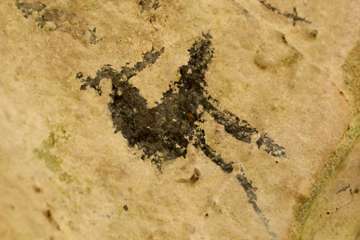
Taino rock painting (Dominican Republic 4000 years ago) depicting a humpback whale.
The position of this whale cannot be observed from the surface. It is arched, with pectorals at rest, characteristic of a socializing whale, and the person who painted this whale, perhaps 4000 years ago, was used to working with it underwater...
Our mission is to renew this link
Musical interaction with the humpback whales of the Caribbean is the key to renewing the dialogue with these animals... recreating the link.
The three main areas of work :
- The Shelltone Whale Project team communicates daily with Guadeloupe's humpback whales using Shelltone, gradually establishing a musical dialogue. This music helps to create an intimate relationship and re-establish ties with these cetaceans.
- We are preparing to form an orchestra of young musicians who will learn the music of the whales and then take them out to sea to play with them.
- We're going to meet musicians and scientists from other Caribbean islands where humpback whales live, to initiate multidisciplinary exchanges.
Learning whale music at the Petit Bourg music and dance school:
- This year, the Petit Bourg music school, in collaboration with Shelltone Whale Project, is offering its students whale singing and music sessions.
- Each student in this «formation» plays the instrument he or she usually works on, and Pierre Lavagne de Castellan teaches the students the melodies of the whales.
- Students compose their own song inspired by whale song.
The idea is that, in time, young musicians will be able to play with humpback whales, on a catamaran specially designed for inter-species communication. Using music as a vector of communication, we hope to renew the link between humans and whales in Guadeloupe and throughout the Caribbean.
Guadeloupe is thus on the way to becoming the first island in the world where children play music with the whales that inhabit its waters, inter-species communication elevated to an art form... A sharing and mutual recognition that is destined to be perpetuated from generation to generation...
The search for the lost music of the Kalinagos...
For thousands of years, humpback whales have been inspired by the music of the people who live along the coasts of the areas they frequent. They have built up their musical repertoire in collaboration with these people. They then use this repertoire to transmit proteodic songs from generation to generation, which they use for the functions we are developing here. However, in the Caribbean, the pre-Colombian populations of the Taïnos, Arrawacs, Carïbes, Kalinagos... have practically all been decimated. Only in Dominica do descendants of this population remain. The trauma of the invasion of their territory, the genocide they suffered and the colonization they subsequently underwent caused them to lose most of their culture, including their music.
Humpback whales, however, have preserved this music, which they still pass on, play and use to convey proteodic songs from generation to generation.
One of the aims of Shelltone Whale Project is to recover this music from the songs of the whales of the Caribbean, and hand it down to the Kalinago people still living in Dominica.
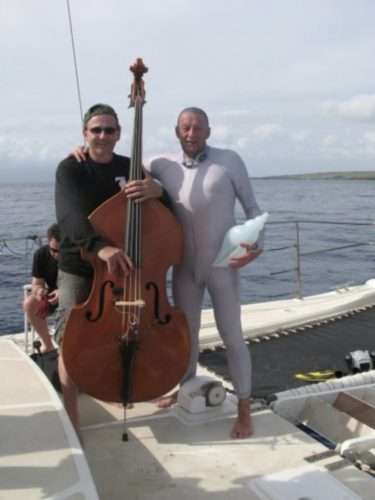
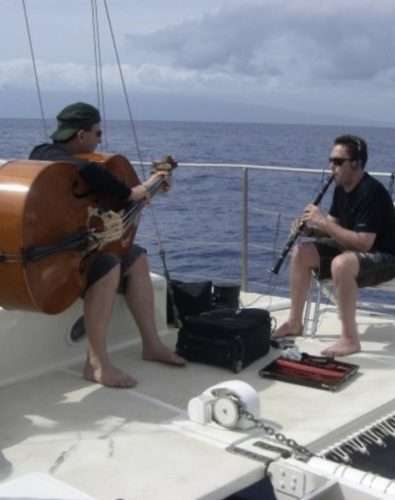
Pierre Lavagne de Castellan in Maui Hawaii, with David Rothenberg and Dan Sythe.