Navigation zones
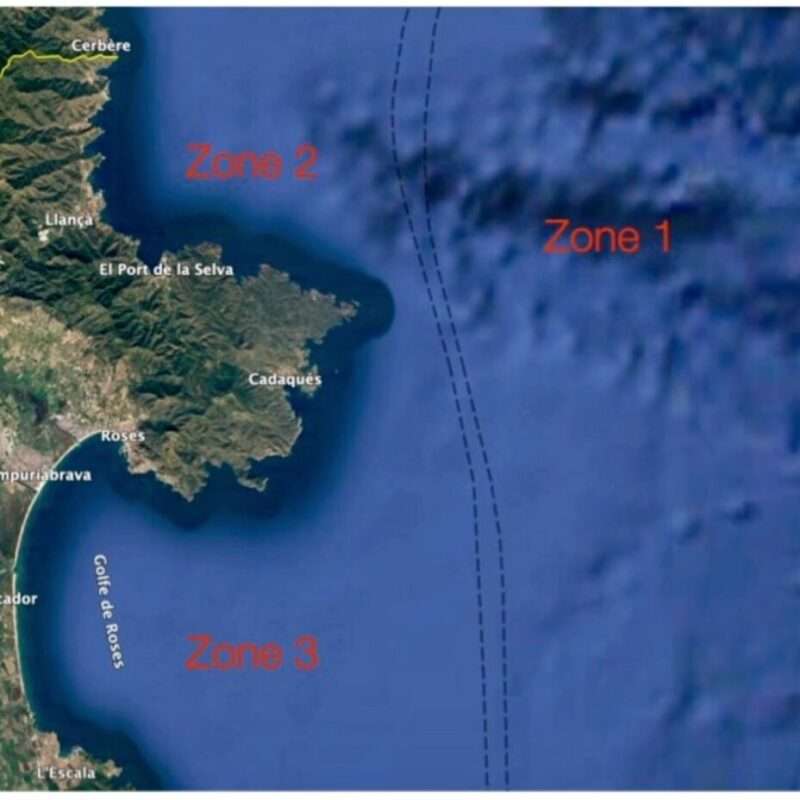
Depending on the day's weather, we decide on one of the 3 navigation zones, the wind and swell being the determining factors. The fish on which the dolphins we observe feed follow the wind and current.
Dolphins don't like to face wind and waves, so they'll do what the fish they're chasing do: take cover.
There are 3 areas on Cap de Creus where we can go, so we'll choose the one most protected from the wind and waves.
- Zone 1 Situated on the Cap de Creus canyon, it's the perfect choice if there's no wind or waves. The canyon descends to a depth of 2,000 meters (around the canyon, the average depth is only 150 meters). It's a very rich ecosystem, with all the marine flora and fauna living there sheltered from the strong underwater currents because they're protected in the depths.
- Zone 2 Located to the north of Cap de Creus, it stretches from the cape to Port de la Selva. This area is ideal for sailing in strong southerly winds, as it is protected by the cape. A circular current is created, and surface fish such as sardines and mackerel, which cetaceans love, find their way here, making this area a hunting ground for dolphins.
- Zone 3 Located to the south of Cap de Creus, it stretches from the cape to Roses. This area is ideal for sailing in strong northerly winds, such as the Tramontane, as the sailing area is protected by the cape. A circular current is created, and surface fish such as sardines and mackerel, which cetaceans love, find their way here, making this area a hunting ground for dolphins.
Cetaceans living in our research area
Here is a brief presentation of the animals we observe in our research territory. If you'd like to find out more about these three species, we strongly recommend you take a look at the Internet, where you'll find a wealth of fascinating information to help you prepare for your outing.
How to spot them from the boat:
Their dorsal fin, as well as the splashes they produce when swimming and jumping, help to pinpoint their position. As soon as you think you've spotted them, tell the captain, he'll check, but then remain silent ... shhh ...
We have 3 species of year-round resident dolphins in our research area: thee Tursiops truncatus or Bottlenose dolphin, the Stenella coeruleoalba or Blue and white dolphin and the Delphinus delphis or Short-beaked common dolphin.
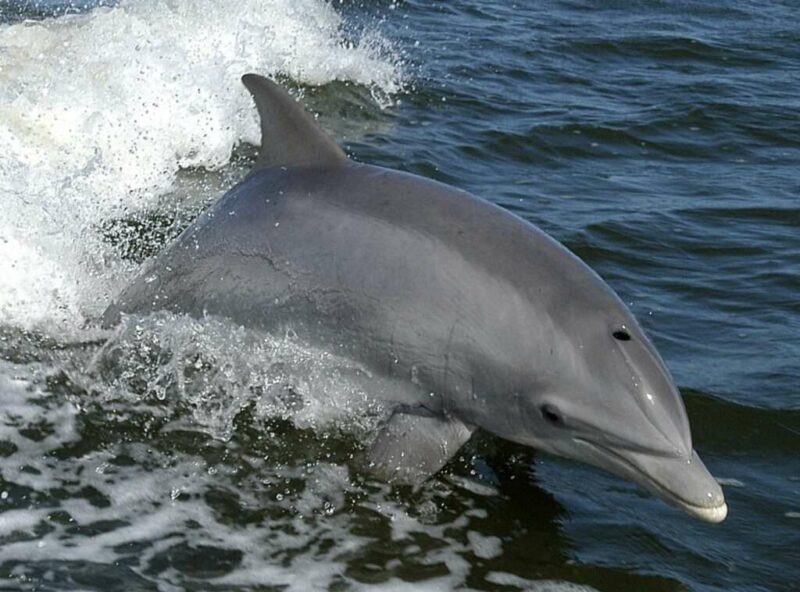
1 - Tursiops truncatus or Bottlenose dolphin:
Bottlenose dolphins generally measure 2 to 4 meters in length, and weigh 150 to 400 kilograms.
Color: Various shades of gray on the back, and white on the belly. On the sides, the gray is paler. This coloring provides a camouflage effect.
Location, it's an «inshore» dolphin, he'll sleep close to the coast at night, but during the day we find him hunting in our 3 zones.
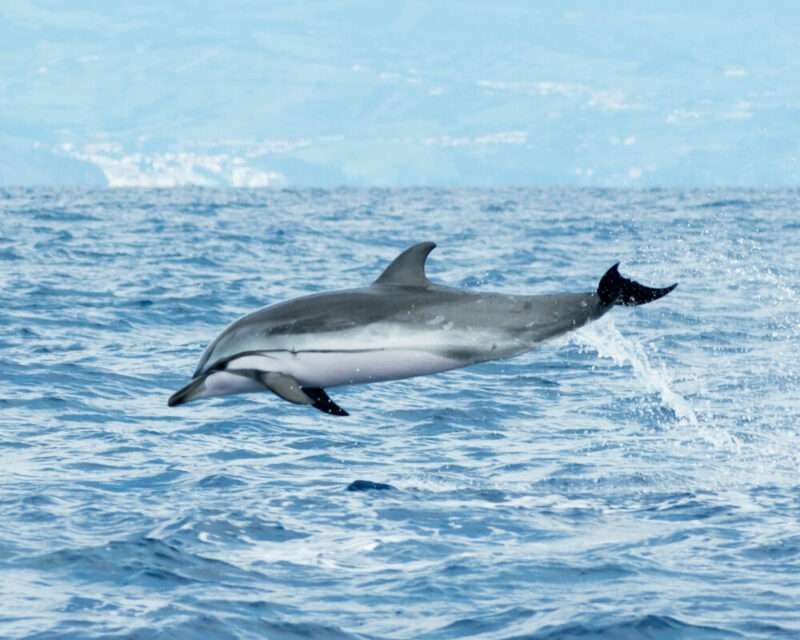
2 - The Stenella coeruleoalba or Blue and White Dolphin
Blue and white dolphins generally measure between 1.90 m and 2.60 m for 80 to 150 kg.
Color: Sickle-shaped dorsal fin, fairly dark back, gray, white and blue flanks. This dolphin has about three blue stripes starting from the eye, a small notch on the caudal fin, and one or two blue stripes running from the flank to the dorsal fin.
Location: a pelagic dolphin, it lives offshore in the canyon, about 6 nautical miles (10 km) from the coast, but can come close to shore to hunt.
3 - Delphinus delphis or Short-beaked common dolphin
Size: from 180 to 260 cm with a mass varying from 75 to 115 kg
Color : The back is bluish-gray to black. The flanks feature two large light spots (buff for the front spot and light gray for the rear) that meet at a point just below the dorsal fin.
Location Blue and white: also pelagic, it lives offshore in the canyon, but like the blue and white, it can come close to shore to hunt.