Whale Watching in Benin
A Scientific and Technical Feasibility Mission for Respectful Whale Watching
An Official Mission of Expertise
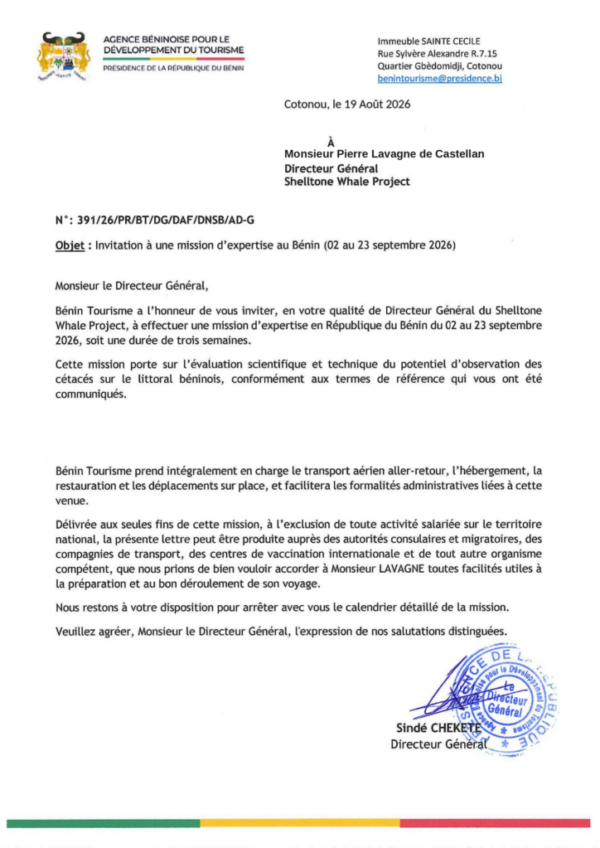
At the invitation of Benin Tourism (Agence Béninoise pour le Développement du Tourisme), an agency attached to the Presidency of the Republic of Benin, the Shelltone Whale Project conducted a scientific and technical assessment of the potential for whale watching along the Beninese coastline from September 2 to 23, 2026.
The mission was formally established through an official invitation dated August 19, 2026, requesting the expertise of the Shelltone Whale Project to evaluate whether the waters off Cotonou could support the development of a seasonal whale-watching activity.
The objective was not to assume that whale watching should be developed, but to determine whether the conditions observed at sea could justify such an activity, conducted according to the principles of respectful whale watching.
The mission also examined the possibility of developing local expertise by training future Beninese whale-watching guides, should the scientific and operational findings support the development of the activity.
The Scientific Mission — Methodology
Preparing the Expedition
Before conducting field surveys, the Shelltone Whale Project examined the marine environment off Cotonou, including seabed topography, bathymetry, ocean currents, prevailing winds and sea conditions.
Available scientific information on cetacean presence in the region was also reviewed.
This preliminary analysis identified two offshore sectors, both within 15 nautical miles of Cotonou harbour, whose underwater topography appeared potentially favourable to whale presence.
These areas were selected as starting points for the surveys, not as confirmed whale habitats.
Integrating Local Maritime Knowledge
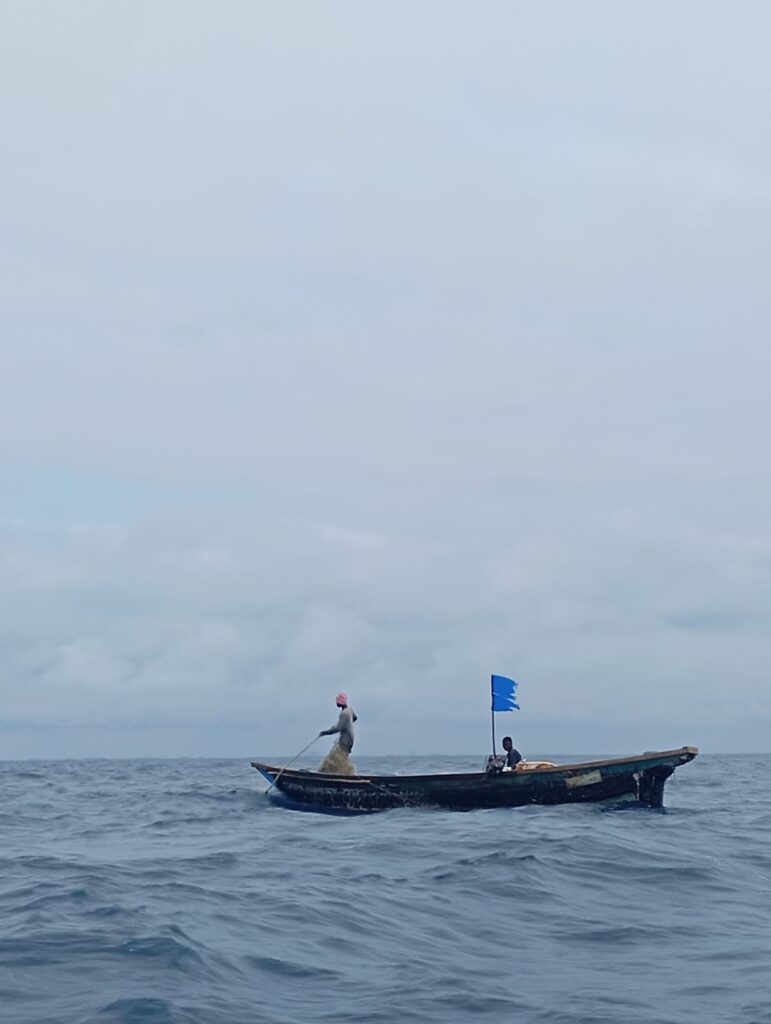
The mission also drew upon the experience of local fishermen, sailors and underwater hunters familiar with the coastal waters of Benin.
Their knowledge provided valuable indications about seasonal whale and dolphin presence and helped guide the initial search strategy.
Local testimonies were treated as contextual information rather than scientifically verified observations. Direct sightings recorded during the mission remained the primary source of field data.
Ten Offshore Survey Expeditions
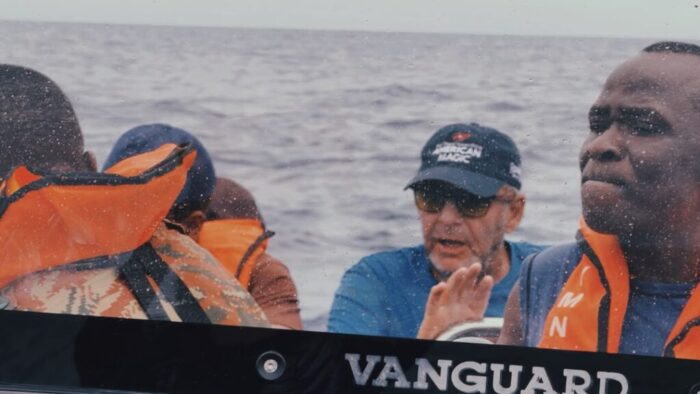
Between September 2 and 23, 2026, ten offshore surveys were conducted from Cotonou.
Search routes were organised around predefined sectors and adapted to the conditions encountered at sea.
Everyone aboard was encouraged to participate in visual scanning, looking for whale blows, breaches and other signs of cetacean activity.
Additional environmental indicators, including seabird concentrations and surface disturbances associated with fish activity, were also considered when directing the search.
During the surveys, the vessel generally travelled at approximately 10 knots. Once a whale was detected, speed was immediately reduced before initiating the observation protocol.
All ten planned surveys were completed.
Acoustic Exploration
A directional hydrophone was used as a complementary research instrument, generally at the beginning of each expedition.
The vessel remained stationary with its engines switched off for approximately 15 minutes while acoustic listening was conducted.
Faint acoustic signals compatible with humpback whale vocalisations were detected during some listening sessions.
However, their low intensity did not allow reliable determination of the animals’ direction or distance.
Acoustic observations were therefore considered supplementary information and were not used to calculate encounter rates or establish whale locations.
Respectful Whale Observation Protocol
All encounters followed the Shelltone Whale Project’s principles of respectful whale watching.
When whales were detected, vessel speed was reduced and their movements and behaviour were assessed before any closer approach.
The observation protocol established a minimum distance of 100 metres and a maximum observation duration of 30 minutes.
When whales were travelling, the vessel maintained a parallel course, adapting its speed to the animals’ movements. When whales remained in one area or displayed repeated breaching behaviour, the vessel remained stationary.
Particular attention was given to females accompanied by calves.
The fundamental principle was that an animal’s behaviour always took precedence over numerical limits.
Respecting a minimum distance or maximum observation time was never considered sufficient justification to continue an interaction if the whale’s behaviour indicated possible disturbance.
In such circumstances, the observation was interrupted and the vessel withdrew.
GPS Recording and Scientific Traceability
Field observations were recorded in real time using a GPS-equipped Crosscall CORE-T4 tablet running Garmin software.
Georeferenced records documented whale sightings, vessel routes and surveyed areas.
Data collection was conducted by a single observer, Pierre Lavagne de Castellan, to maintain a consistent observation and recording methodology throughout the mission.
Following each expedition, the recorded information was transferred into the mission’s monitoring table by the same observer.
This procedure ensured continuity and traceability across the ten surveys.
Field Observations & Scientific Results
Humpback Whales in Beninese Waters
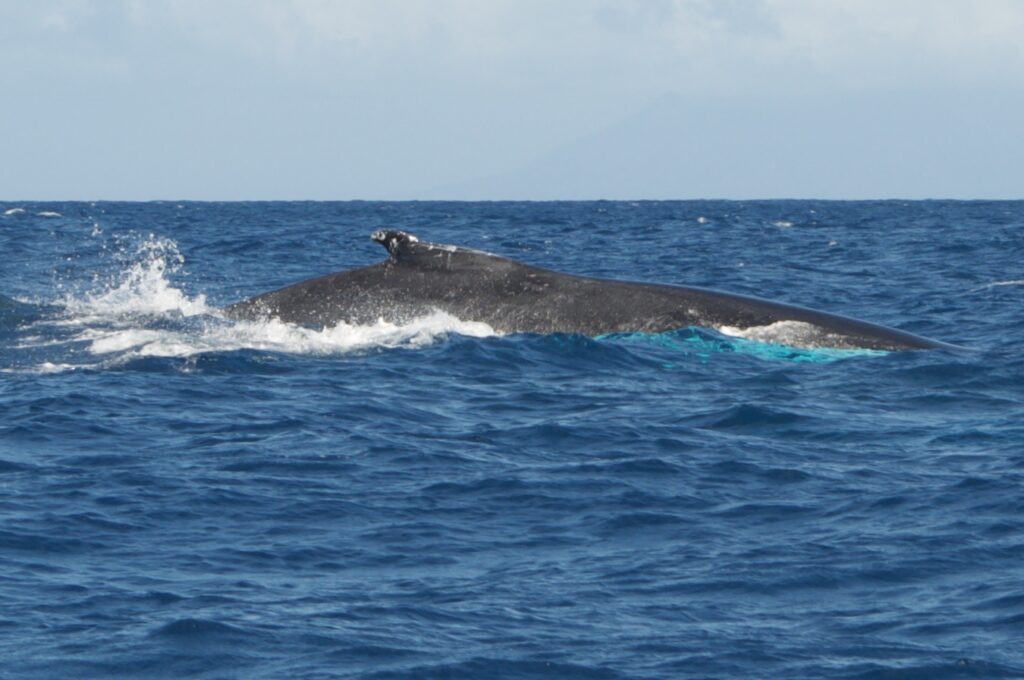
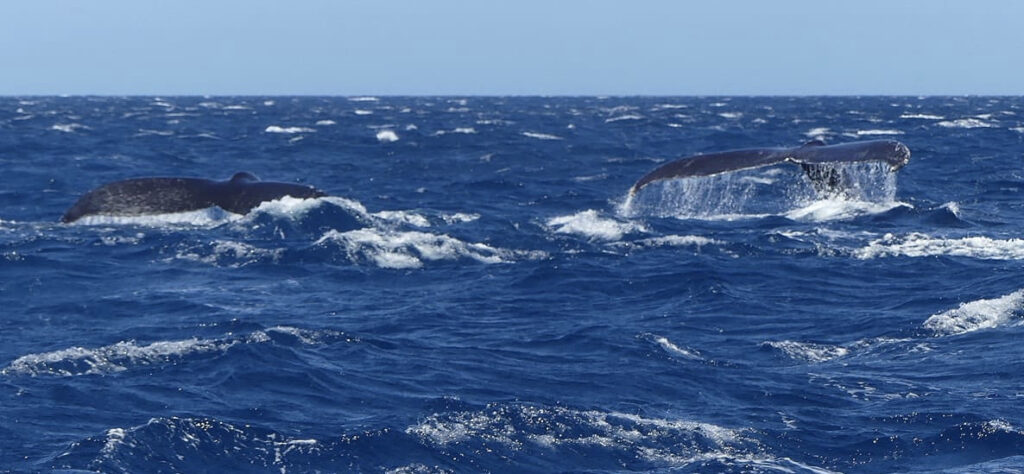
During the ten offshore surveys conducted in September 2026, humpback whales (Megaptera novaeangliae) were the only cetacean species directly observed by the Shelltone Whale Project.
Identification was based on characteristic morphological features, particularly the whales’ exceptionally long pectoral fins. The individuals observed displayed dark upper surfaces and white undersides on these fins.
The encounters involved different group compositions, including adults, juveniles, mothers accompanied by calves, and individuals interpreted as possible male escorts based on their position and behaviour within the groups.
The identification of these escorts as males remains a behavioural interpretation rather than a confirmed determination of sex.
Raya — A Recognisable Mother and Her Calf
One of the most significant observations involved a female humpback whale accompanied by her calf.
The female displayed a distinctive, continuous white marking along her dorsal region, allowing her to be recognised during several encounters with a high degree of confidence.
She was given the name Raya during the mission.
The same calf was consistently observed alongside her. An additional whale, interpreted as a possible male escort, was also present during these encounters.
However, because this third individual lacked an equally distinctive identifying feature, it was not possible to establish with the same confidence whether it was always the same whale.
For the other humpback whales encountered during the expedition, the available observations did not permit sufficiently reliable individual reidentification.
Consequently, the number of encounters recorded during the mission must not be interpreted as the total number of different whales present in the area.
Whale Behaviour — Travelling, Breaching and Possible Feeding Activity
Three main categories of humpback whale behaviour were documented during the surveys.
Directional travelling
Some whales followed relatively consistent routes. Raya, her calf and the presumed escort were notably observed travelling in a northwesterly direction.
Breaching
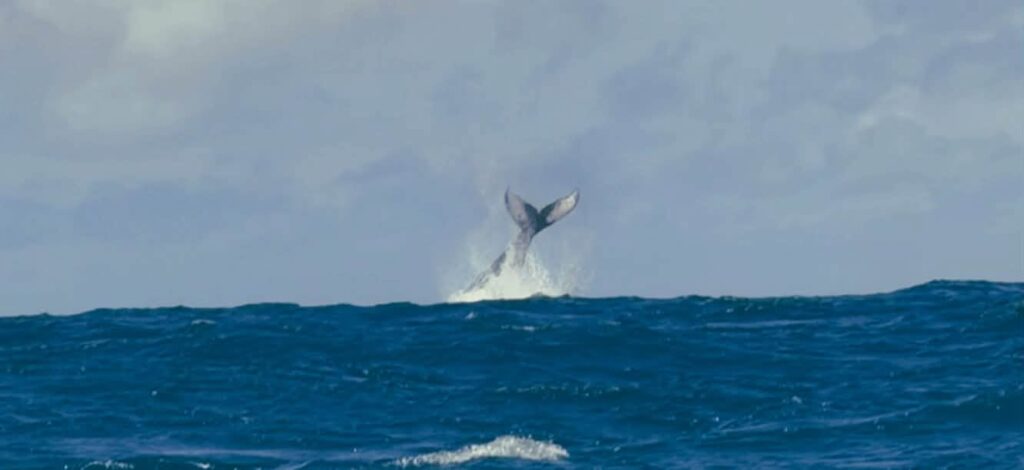
Repeated breaches, during which whales propelled themselves partially or entirely out of the water, were observed among individuals other than Raya’s group.
Behaviour compatible with feeding activity
A third category involved whales remaining within a relatively restricted area, estimated at approximately three square nautical miles.
Instead of following a consistent direction, the animals repeatedly changed course, surfaced more frequently and displayed faster, more abrupt swimming movements.
This pattern was described as triangulation in the field records.
The presence of seabirds in the same area provided an additional indication of possible food concentration.
Taken together, these observations were interpreted as compatible with feeding activity. This interpretation was also consistent with local fishermen’s accounts of krill occurring in the waters off Cotonou.
However, no biological sampling of potential prey was conducted during the mission.
Feeding activity therefore remains a plausible behavioural interpretation, not a scientifically confirmed finding.
Acoustic Observations
Directional hydrophone listening sessions occasionally detected very faint, distant acoustic signals compatible with humpback whale vocalisations.
These signals did not appear to originate from the whales being visually observed at the same time.
Their low intensity prevented reliable determination of the distance or direction of the possible vocalising animals.
No acoustic localisation was therefore established.
These observations provide supplementary information but were not included in the calculation of whale encounter rates or the identification of observation areas.
Whale Encounter Rate — 70% During the Study Period
Across the ten offshore surveys:
- Humpback whales were visually observed during seven surveys.
- Three surveys produced no visual whale sightings.
- The resulting observed encounter rate was 70%.
For this calculation, each survey was considered a single sampling unit. A survey was classified as positive when at least one whale was observed, regardless of the number of separate encounters during that outing.
This 70% figure describes the results obtained during the September 2026 mission only.
It must not be interpreted as a predicted encounter rate for the entire whale-watching season, for other months, or for subsequent years.
Further standardised monitoring will be necessary to evaluate seasonal and interannual variations.
Geographic Distribution — An Accessible Offshore Observation Area
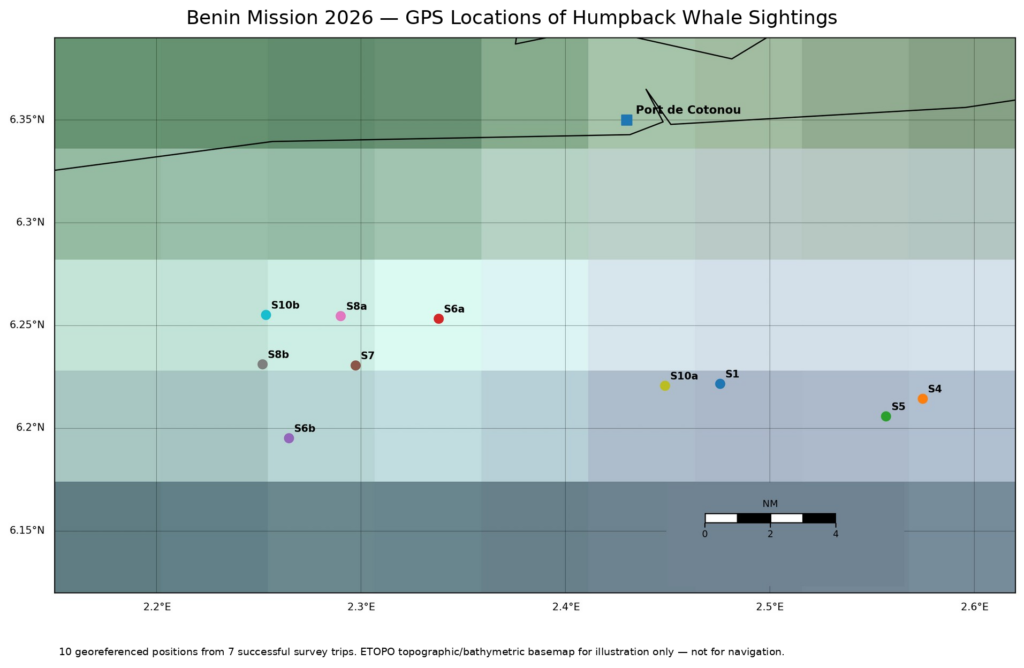
GPS positions recorded during the mission showed that humpback whale encounters were concentrated primarily between 5 and 8 nautical miles from the Beninese coastline, offshore from Cotonou.
The recorded positions extended approximately between:
- Latitude: 6°11.7′ N and 6°15.3′ N
- Longitude: 2°15.1′ E and 2°34.5′ E
These findings demonstrate that, during the study period, humpback whales were present in an offshore area accessible from Cotonou without requiring prolonged offshore navigation.
The geographical distribution of the encounters was documented through GPS records and presented in the mission’s observation map.
Other Cetaceans — Local Knowledge and Scientific Limits
No cetacean species other than humpback whales was directly observed during the ten surveys.
However, interviews with local fishermen and sailors repeatedly indicated the seasonal presence of dolphins, reportedly particularly abundant during March and April.
The descriptions suggested dolphins potentially belonging to the genus Tursiops.
Because these accounts were not supported by direct observations or photographic documentation during the mission, the proposed identification remains unconfirmed.
The September 2026 survey therefore provides a documented account of humpback whale observations during the study period, rather than a comprehensive annual inventory of cetacean species occurring in Beninese waters.
Feasibility of Respectful Whale Watching in Benin
A Positive Scientific and Technical Assessment
The principal objective of the Shelltone Whale Project’s September 2026 mission was to determine whether the marine conditions off Cotonou could support the development of a seasonal whale-watching activity conducted according to respectful observation principles.
The findings support a positive assessment for the period studied.
Humpback whales (Megaptera novaeangliae) were observed during seven of the ten offshore surveys. Encounters occurred primarily between 5 and 8 nautical miles from the coastline, within an area accessible from Cotonou.
All ten scheduled surveys were completed, and the conditions encountered allowed navigation, whale searches and observation activities to be conducted satisfactorily.
Taken together, these findings demonstrate that the conditions documented during the mission were compatible with the development of seasonal whale watching from Cotonou.
An Accessible Offshore Observation Area
The geographical distribution of whale encounters is an important operational finding.
The principal observation area was situated at a distance that could be reached from Cotonou without requiring extended offshore expeditions.
This accessibility provides a favourable starting point for considering organised whale-watching excursions.
However, the observations do not establish that whales will be present in the same areas, or with the same frequency, throughout the season.
What the Mission Demonstrated — and What Remains to Be Established
The September 2026 assessment documented three essential conditions:
- The presence of humpback whales in the surveyed waters.
- Their occurrence within an offshore area accessible from Cotonou.
- The practical possibility of conducting the planned surveys and observing the animals under satisfactory conditions during the study period.
These findings provide a scientific and technical basis for considering a seasonal whale-watching activity.
They do not, however, establish the encounter rate for the entire season or predict variations between successive years.
Further monitoring will be necessary to document these changes and progressively refine the understanding of humpback whale presence in Beninese waters.
Respectful Whale Watching as a Founding Principle
A favourable feasibility assessment does not, by itself, justify increasing the number of interactions between vessels and whales.
The Shelltone Whale Project recommends that respectful whale-watching principles be incorporated from the very beginning of any future activity, rather than introduced later as corrective measures.
Operational rules governing vessel speed, approach distance and observation duration provide an essential framework.
But these numerical limits remain subordinate to a more fundamental principle:
The behaviour of the whale must determine whether an observation continues, changes or ends.
The decision not to approach an animal, or to interrupt an encounter when circumstances require it, must be recognised as a normal and necessary part of responsible whale watching.
From Feasibility to Responsible Development
The mission establishes a favourable scientific and technical starting point for considering seasonal whale watching in Benin.
Turning this potential into an operational activity will require further preparation, including the development of local professional expertise, the application of respectful observation procedures and the establishment of regular scientific monitoring.
The September 2026 mission was not intended to produce a commercial business plan. Ticket prices, vessel capacity, operating frequency, visitor demand, operating costs and profitability remain to be assessed separately.
The conclusion is therefore positive but precisely defined: respectful seasonal whale watching is a realistic development possibility under the conditions documented off Cotonou in September 2026, provided that its future implementation is supported by appropriate operational preparation and continued observation.
Building Local Expertise in Benin
Developing Beninese Whale-Watching Expertise
Beyond assessing the scientific and technical feasibility of whale watching, the September 2026 mission examined the conditions required to develop local professional expertise in cetacean observation.
The Shelltone Whale Project recommended that the future activity be built around the training of young Beninese whale-watching guides.
The objective is not simply to introduce a new tourism experience, but to create the conditions for Benin to progressively develop its own specialised knowledge and operational capabilities.
The Role of a Professional Whale-Watching Guide
A whale-watching guide’s responsibilities extend well beyond locating animals and presenting them to passengers.
The Shelltone Whale Project’s proposed training approach encompasses several complementary skills:
- Detecting cetaceans at sea and recognising relevant environmental indicators.
- Identifying observed species and interpreting whale behaviour.
- Understanding respectful observation principles and communicating appropriate approach requirements to the captain.
- Explaining cetacean biology, behaviour and marine ecology to passengers.
- Documenting observations through standardised records, GPS positions and photographic identification.
- Contributing to the progressive accumulation of scientific knowledge about whales visiting Beninese waters.
This approach places the guide at the intersection of environmental interpretation, responsible tourism and field observation.
Guides and Captains — Complementary Responsibilities
Respectful whale watching depends on effective cooperation between the guide and the vessel’s captain.
The guide is responsible for observing the animals, interpreting their behaviour and communicating the requirements of a respectful encounter.
The captain retains responsibility for vessel navigation and maritime safety.
Nautical training for captains must be provided by appropriately qualified professionals. Once the necessary skills are established, guides and captains should be trained to work together so that vessel movements can be adapted to the animals’ behaviour without compromising safety.
Learning Through Real Encounters
The Shelltone Whale Project recommends a progressive training approach combining theoretical knowledge with practical experience at sea.
Direct observation allows future guides to develop skills that cannot be acquired through classroom instruction alone: detecting whales, recognising behavioural changes, making appropriate observation decisions and communicating with passengers and the captain.
As their competence develops, trainees should progressively assume greater responsibility for conducting observations, under professional supervision.
The intended outcome is the development of guides capable of working autonomously and responsibly.
Making Every Excursion a Source of Knowledge
A central recommendation of the mission is to integrate scientific data collection into the ordinary work of future whale-watching guides.
Using a standardised observation record, each excursion could contribute information on whale presence, geographical distribution, group composition and behaviour.
Photographic identification could also help recognise individual whales during successive encounters and across different seasons.
Over time, this consistent collection of georeferenced observations could improve knowledge of humpback whales visiting Beninese waters.
Passengers could also discover how these observations contribute to understanding marine wildlife, making whale watching an experience of learning and environmental awareness as well as observation.
Building Long-Term Local Autonomy
The Shelltone Whale Project’s proposed role is to transmit its respectful observation methods, support the training of Beninese guides and accompany their progressive acquisition of practical experience.
The long-term objective is for the activity to rely on autonomous Beninese expertise rather than on the permanent presence of foreign specialists.
Benin would not simply be developing a new whale-watching destination. It would be developing its own whale-watching expertise from the beginning of the activity.
Economic Potential & Development Perspectives
A New Nature-Based Tourism Opportunity for Benin
The findings of the September 2026 mission indicate that seasonal whale watching could become a new component of Benin’s tourism offering.
The documented presence of humpback whales, their accessibility from Cotonou and the satisfactory conditions encountered during the surveys provide a favourable starting point for considering the development of this activity.
Beyond the opportunity to observe whales, the project could contribute to the diversification of nature-based tourism in Benin, while encouraging greater awareness of the country’s marine environment.
An Activity for Beninese Residents and Regional Visitors
The Shelltone Whale Project recommends that whale watching should not be conceived exclusively as an activity for international tourists.
Residents of Benin and visitors from neighbouring countries could form an important part of its potential audience.
Providing opportunities for Beninese people to discover humpback whales in their own waters could also contribute to a stronger connection with the country’s marine natural heritage.
A locally accessible activity would therefore have value beyond its immediate commercial potential.
International Tourism Potential
Whale watching could also complement the experiences available to international visitors travelling to Benin.
If developed successfully, Cotonou could progressively establish itself as a seasonal destination for humpback whale observation.
Such positioning would need to be supported by reliable operational standards, appropriately trained local professionals and a consistent commitment to respectful whale watching.
The objective would not simply be to attract visitors, but to develop an activity whose environmental credibility forms part of its identity from the beginning.
Economic Feasibility Requires Further Assessment
The September 2026 mission was designed to assess scientific, technical and operational feasibility. It was not intended to establish a complete commercial business plan.
Several economic parameters remain to be determined, including:
- Excursion pricing and expected visitor demand.
- Suitable vessel types and passenger capacities.
- The number and frequency of potential excursions.
- Operating costs and staffing requirements.
- Seasonal commercial performance and profitability.
These questions will require a separate economic assessment based on the operational model ultimately selected.
The positive results of the mission therefore establish an opportunity for further development, not a guarantee of commercial success.
Responsible Development as a Long-Term Asset
The Shelltone Whale Project recommends that environmental responsibility and local professional expertise should be integral to the future activity.
Respectful observation procedures, trained Beninese guides and the regular collection of field data could help establish a credible foundation for its development.
The long-term opportunity is to combine a new seasonal tourism activity with the progressive development of local expertise and a better understanding of humpback whales visiting Beninese waters.
The economic opportunity identified by the mission is therefore inseparable from the conditions under which the activity would be developed.
Marine Wildlife Conservation & Responsible Observation
Beyond Whales — A Consistent Principle of Respect
The Shelltone Whale Project’s September 2026 mission focused primarily on assessing the potential for respectful whale watching off Cotonou.
The mission also identified two subjects deserving further investigation: marine turtles and manatees.
Although insufficient information was collected to assess the feasibility of observing these animals, their consideration raises a broader question: how should wildlife observation activities be developed without compromising the welfare of the animals concerned?
For the Shelltone Whale Project, the answer begins with the same principle that guides respectful whale watching:
Wildlife observation must adapt to the animals, never require the animals to adapt to human expectations.
Marine Turtles — Further Investigation Required
The mission did not collect sufficient evidence to assess the potential for marine turtle observation activities in Benin.
This absence of findings should not be interpreted as evidence that such opportunities do not exist.
Further investigations would be required to establish whether observation activities could be developed responsibly, taking into account the species present, their habitats and their sensitivity to human disturbance.
Any future activity should be based on species-specific scientific knowledge and appropriate observation procedures, with particular attention to avoiding disturbance during vulnerable stages of the animals’ life cycles.
Manatees — A Potential Subject for Future Research
Similarly, the September 2026 mission did not gather sufficient information to evaluate the feasibility of manatee observation in Benin.
No positive or negative conclusion can therefore be drawn from the mission’s findings.
Further dedicated investigations would be necessary before considering any observation activity.
Should such an activity eventually be contemplated, its development would need to follow rigorous standards adapted to manatee behaviour, habitat requirements and vulnerability to disturbance.
Respectful Observation Requires Species-Specific Standards
The principles underlying respectful whale watching can inform a broader approach to observing marine wildlife.
However, the operational rules developed for whales cannot simply be transferred unchanged to other species.
Each activity must be assessed according to the biology, behaviour and conservation needs of the animals concerned.
The Shelltone Whale Project recommends that any future wildlife observation initiative be supported by appropriate scientific assessment, qualified local professionals and clear procedures designed to minimise disturbance.
The development of nature-based tourism should never take precedence over the welfare of the wildlife that makes these experiences possible.
Scientific Monitoring & Future Perspectives
Turning Every Whale-Watching Excursion into an Opportunity for Research
One of the Shelltone Whale Project’s principal recommendations is to establish a continuous scientific monitoring programme alongside any future whale-watching activity in Benin.
The September 2026 mission provided an initial set of georeferenced observations documenting humpback whale presence, group composition, behaviour and geographical distribution.
These findings constitute a starting point rather than a complete understanding of the seasonal occurrence of whales in Beninese waters.
Future excursions could progressively expand this knowledge through the regular collection of standardised field observations.
A Standardised Observation Protocol
The observation records developed during the mission provide a practical foundation for future monitoring.
For each excursion, trained Beninese guides could document:
- Survey date, navigation conditions and observation conditions.
- Areas explored and GPS positions of whale encounters.
- Species identification and number of animals observed.
- Group composition, including the presence of calves.
- Observed behaviours and direction of travel.
- Duration and circumstances of each observation.
Using a consistent methodology would allow observations to be compared over time and help document variations in whale occurrence between different periods and successive seasons.
The objective is to create a simple, reliable monitoring system that can be maintained as part of the guides’ normal professional activities.
Photo-Identification — Recognising Individual Whales
Photographic identification represents another important component of the proposed monitoring programme.
Distinctive physical characteristics can sometimes allow individual humpback whales to be recognised during separate encounters.
The repeated identification of Raya, the female observed with her calf during the September 2026 mission, illustrates the value of this approach.
The Shelltone Whale Project recommends equipping future guides with suitable photographic equipment, including a telephoto lens of approximately 300 mm, to document identifiable characteristics without altering respectful observation distances.
Photographs should remain associated with the corresponding observation records, including date, GPS position and observed behaviour.
Over successive seasons, a photographic catalogue could help identify returning individuals and contribute to a better understanding of the whales frequenting Beninese waters.
A First Operational Season — Combining Observation and Training
The positive findings of the September 2026 mission provide a basis for considering the preparation of an initial operational whale-watching season in Cotonou.
Such a season could serve several complementary objectives: introducing respectful whale-watching excursions, training the first Beninese guides through practical experience and beginning a continuous programme of scientific monitoring.
In this perspective, the Shelltone Whale Project could accompany the initial season by providing specialised training, transmitting its observation methods and supervising trainees during encounters at sea.
The training approach would be progressive, allowing future guides to develop their ability to detect whales, interpret behaviour, communicate with captains and assume increasing responsibility for the observation experience.
The ultimate objective would be to establish autonomous Beninese professional expertise.
Building Knowledge and Expertise Over Time
The long-term value of the proposed activity would extend beyond the number of whales observed or excursions organised.
With appropriate training and consistent data collection, each season could contribute to a growing body of knowledge about humpback whales in Beninese waters.
At the same time, the development of local professional skills would allow this knowledge to be collected, interpreted and transmitted by Beninese guides themselves.
The ambition is to develop respectful whale watching and local scientific observation together, so that the activity contributes to understanding the marine environment on which it depends.
Conclusions & Official Mission Report
A Scientific Foundation for Respectful Whale Watching in Benin
The scientific and technical assessment conducted by the Shelltone Whale Project in Cotonou from September 2 to 23, 2026, at the invitation of Benin Tourism, produced a positive conclusion regarding the potential for seasonal whale watching during the period studied.
Humpback whales (Megaptera novaeangliae) were observed during seven of the ten offshore surveys, corresponding to a 70% encounter rate. Most encounters occurred between 5 and 8 nautical miles from the coastline, within an area accessible from Cotonou.
All ten scheduled surveys were completed under conditions that allowed satisfactory navigation, prospecting and whale observation.
These findings support the possibility of developing a seasonal whale-watching activity, while recognising that further monitoring will be necessary to understand variations throughout the season and between successive years.
A Commitment to Responsible Development
The Shelltone Whale Project recommends that any future whale-watching activity in Benin be founded on three complementary principles:
- Respect for cetaceans: observation procedures must prioritise animal behaviour and welfare over the pursuit of encounters.
- Development of local expertise: specialised training should enable Beninese guides to progressively assume responsibility for respectful whale observation.
- Continuous scientific monitoring: regular field observations and photographic identification should contribute to a growing understanding of humpback whales in Beninese waters.
Together, these principles provide a framework for developing an activity that combines nature-based tourism, professional training and environmental responsibility.
Official Mission Report — September 2026
The findings, methodology, observations, operational assessment and recommendations presented on this page are based on the Shelltone Whale Project’s final mission report:
Scientific and Technical Assessment of the Potential for Cetacean Observation Along the Beninese Coast
Cotonou, Benin — September 2–23, 2026
Pierre Lavagne de Castellan
Director of Research — Shelltone Whale Project
Mission conducted at the invitation of Benin Tourism (Agence Béninoise pour le Développement du Tourisme).
The report provides the complete scientific and technical record of the mission, including the survey findings, operational conclusions, recommendations and supporting documentation.


 English
 Français
 Español